



Nonprofit Board Governance: Roles, Responsibilities, and Common Mistakes
A nonprofit’s board is the group legally responsible for the organization. It doesn’t run the day-to-day work, but it answers for how the mission is pursued and how every dollar is used.
Many boards are made up of caring volunteers who joined because they believe in the cause, and who were never told exactly what the job involves. That gap is where most governance problems start.
What a Nonprofit Board Actually Does
According to the National Council of Nonprofits, a board provides foresight, oversight, and insight, rather than managing daily operations once paid staff are in place. Its core responsibilities include:
- Hiring, supporting, and evaluating the executive director
- Adopting sound governance and financial policies
- Making sure the organization has the resources to pursue its mission
- Setting strategic direction and protecting the organization’s financial health
- Raising money, including through personal giving, and advocating for the mission
The simplest way to remember the split: the board decides where the organization is going and checks that it’s getting there. Staff decide how to do the work.
The Three Legal Duties Every Board Member Carries
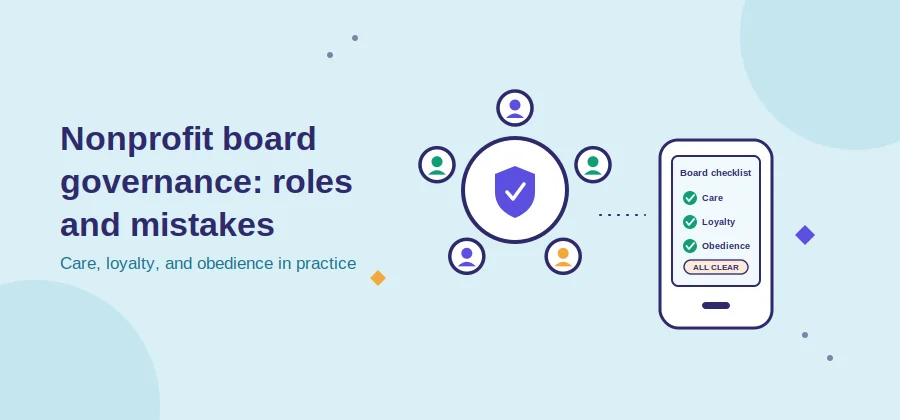
Board members are fiduciaries, meaning they hold the organization’s assets and mission in trust. In the United States, that responsibility is usually described through three duties:
- Duty of care: make informed, prudent decisions and protect the organization’s assets, people, and reputation
- Duty of loyalty: put the organization’s interests ahead of personal ones, and disclose any conflict of interest
- Duty of obedience: make sure the organization follows the law, its own bylaws, and its stated mission
In practice, these duties mean reading the financial reports before voting, speaking up when something doesn’t add up, and never using a board seat for personal gain.
The Core Board Officer Roles
Most boards elect officers from among their members, typically a chair, vice chair, secretary, and treasurer.
- The chair leads meetings, keeps the board focused on governance rather than operations, and works closely with the executive director
- The vice chair supports the chair and steps in when needed, which makes the role a natural part of succession planning
- The secretary keeps accurate records of meetings, decisions, and official documents
- The treasurer oversees the financial picture, making sure the board sees clear, regular reporting
Exact titles and duties vary by organization and are set out in the bylaws, so it’s worth checking those before assuming what a role includes.
Common Board Governance Mistakes
Governance guidance from Zeffy and the National Council of Nonprofits points to a consistent set of mistakes. Most are habits rather than scandals, which is exactly why they go unnoticed.
- Rubber-stamping: approving whatever staff propose without real questions or discussion
- Micromanaging: reaching into daily operations that belong to the executive director
- Neglecting financial oversight: skipping the review of financial statements or audits
- Avoiding the executive director’s evaluation, one of the most important and most often skipped board responsibilities
- Letting conflicts of interest go undisclosed instead of collecting annual disclosure forms
- Having no succession plan for the board chair or the executive director
- Skipping onboarding, so new members join without understanding their role
The Council of Nonprofits describes a conflict of interest policy as arguably the most important policy a board can adopt. It’s a simple document that protects both the organization and the people serving on it.
Habits That Keep a Board Healthy
Good governance doesn’t require a large budget. A few steady habits go a long way:
- Give every new member a written role description and a short orientation before their first meeting
- Build a yearly governance calendar so audits, budgets, and evaluations don’t get forgotten
- Record minutes for every meeting, including dissenting views
- Review the board’s own performance regularly, not just the organization’s
- Confirm the organization carries appropriate directors and officers liability insurance
Each of these turns good intentions into a repeatable process, so the board stays effective even as members come and go.
The Board’s Role in Fundraising
Fundraising is a shared responsibility of the board, not only the development team. That doesn’t mean every member must be a skilled solicitor. It means each one gives what they can, opens doors to their networks, and helps tell the organization’s story.
The simplest way to start is by making it easy for members to participate: a clear campaign link to share, a short message they can post, and regular updates on how the campaign is going.
How Ideali Supports Board Oversight and Fundraising
Oversight depends on clear information. Ideali’s Donor Reports give boards a straightforward view of giving activity, so financial and fundraising conversations at the table start from real numbers rather than impressions.
For board fundraising, every campaign can be shared across social media and embedded on a website, and comes with an automatically generated QR code. That gives each board member something simple to share with their own network, without needing any technical setup.
Sign up for Ideali for free to give your board a clearer view of giving and an easier way to share your mission.
Final Thoughts
Strong governance isn’t about bureaucracy. It’s about making sure the people entrusted with a mission understand what they’re responsible for, and have the habits to carry it out.
Boards that know their roles, avoid the common mistakes, and keep their processes simple give the whole organization a steadier foundation.
This article is general information and not legal advice. Board duties and requirements vary by country, state, and province, and by an organization’s own bylaws, so consult a qualified professional for your specific situation.

