



Corporate Matching Gifts: The Free Money Most Nonprofits Leave on the Table
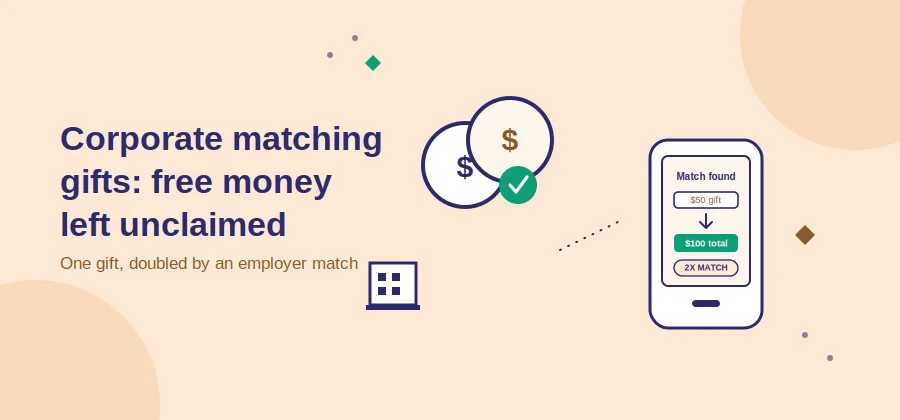
A donor gives $50. Their employer offers to match it dollar for dollar. That match never gets claimed.
This happens far more often than most nonprofits realize. Corporate matching gift programs already exist at thousands of companies, funded and ready to go. The money isn’t hard to raise. It’s hard to claim, and most organizations never ask for it.
An estimated $4 to $7 billion in matching gift funds goes unclaimed every year. For most nonprofits, that isn’t a rounding error. It’s a second fundraising channel sitting untouched.
What a Corporate Matching Gift Program Actually Is
A matching gift program is a corporate benefit where a company agrees to match a portion or all of an employee’s charitable donation, usually dollar for dollar, sometimes at a higher ratio.
If a donor gives $100 to a nonprofit and their employer matches at a 1:1 ratio, the nonprofit receives an additional $100 simply because that donor happened to work somewhere with a matching program. The donor doesn’t give more. The organization still ends up with more.
According to research from Double the Donation, roughly 65% of Fortune 500 companies and 51% of Russell 1000 companies now offer some form of matching gift program. This isn’t a niche benefit limited to a handful of large corporations. It’s increasingly standard.
Why So Much of This Money Goes Unclaimed
The gap between what’s available and what’s actually collected is large. An estimated 10% of individual donations are eligible for a corporate match, yet only about 1.31% of donations at the average nonprofit are actually matched.
The problem isn’t that donors don’t want their gifts matched. It’s that almost nobody along the way tells them the option exists.
The Donor Awareness Gap
Most donors simply don’t know whether their employer offers a matching program, or how to submit a request if it does. Research on donor awareness breaks this down clearly:
- 78% of donors are unaware whether their company offers a matching gift program at all
- 14% know a program exists, but aren’t sure if they qualify or how to submit a request
- Only 8% know their company has a program, know they’re eligible, and understand how to actually submit it
This means the vast majority of donors who could unlock matching funds for a cause they already support simply never find out the option was available to them.
The awareness gap isn’t only a donor problem either. Many nonprofits don’t actively promote matching gifts, don’t mention them during checkout, and don’t follow up afterward, which means even donors who would have checked are never prompted to.
Matches Also Change Donor Behavior
The impact of matching gifts goes beyond the extra dollars from the employer. Donors respond differently when they know a match is on the table.
Research shows 84% of donors say they’re more likely to give when a matching gift opportunity is available, and many give larger amounts once they realize their employer will double the impact. A match doesn’t just add money after the fact. It can influence the decision to give in the first place.
Where to Actually Ask
Capturing more matching gift revenue rarely requires a new campaign. It requires asking at the moments donors are already present.
- On the donation form itself, with a simple prompt asking whether the donor’s employer offers a matching program
- In the thank-you email sent immediately after a gift, while the donor is still thinking about their donation
- In a short follow-up message a few weeks later, as a gentle reminder for donors who may not have checked the first time
Each of these moments already exists in a normal donation flow. The only change is adding one more question donors are often happy to answer, once they know it’s being asked.
This Isn’t a New Fundraising Effort
Most fundraising strategies ask an organization to find new donors, run new campaigns, or invest new staff time. Matching gifts are different. The donor has already given. The company has already committed the funds. The only missing step is a reminder.
For organizations with limited staff capacity, that makes matching gifts one of the highest-return, lowest-effort opportunities available, simply because the hardest part of fundraising, convincing someone to give, has already happened.
How Ideali Helps Nonprofits Capture More Matching Gifts
Closing the matching gift awareness gap comes down to consistent, well-timed communication, not a separate system to manage.
Ideali’s Customized Emails let organizations build a matching gift reminder directly into their automatic thank-you messages, so every donor is prompted to check their eligibility right after giving, without requiring extra staff time for each gift.
Donor Reports also help organizations see which campaigns and donor segments are performing well, making it easier to identify where a matching gift reminder is likely to have the biggest impact.
Sign up for Ideali for free to start turning thank-you messages into matching gift reminders.
Final Thoughts
Corporate matching gifts are one of the few places in fundraising where the money is already committed and simply waiting to be claimed.
The organizations that capture more of it aren’t necessarily doing more work. They’re just remembering to ask, at the moments donors are already there.
Because sometimes the biggest untapped source of revenue isn’t a new donor at all. It’s a donation that already happened, waiting to be doubled.

